

Have you ever wondered why airplanes fly at 35000 feet? Most commercial aircraft cruise at high altitudes because thinner air can reduce drag and improve fuel efficiency, while the aircraft remains within its safe performance limits.
Most commercial aircraft cruise somewhere around 30,000 to 40,000 feet, with 35,000 feet often mentioned as a typical cruising altitude.
But why?
Why don’t airplanes simply fly at 10,000 or 15,000 feet?
The answer is a fascinating combination of physics, aerodynamics, fuel efficiency, weather, engine performance, and air traffic management.
Let’s understand what happens at 35,000 feet and why this altitude is so important to modern aviation.
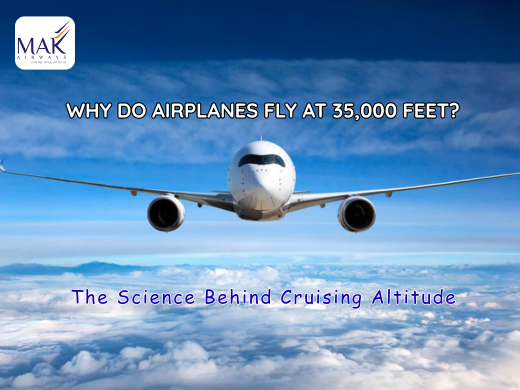
What Makes 35,000 Feet Special?
As an aircraft climbs higher, the atmosphere becomes thinner.
At first, this might sound like a disadvantage. After all, airplanes need air to generate lift.
But flying at high altitude also brings several important benefits.
At cruising altitude, commercial aircraft can find a balance between:
- Lower air resistance
- Better fuel efficiency
- Suitable engine performance
- Reduced weather disturbances
- Efficient long-distance travel
- Organized air traffic
So, 35,000 feet isn’t a magical number that every aircraft must reach. It is simply within a range where many commercial aircraft can operate efficiently.
1. Thinner Air Means Less Drag
One of the biggest advantages of flying at high altitude is reduced air density.
As altitude increases, atmospheric pressure and air density decrease.
An aircraft moving through dense air experiences greater aerodynamic resistance, known as drag.
At higher altitudes, the thinner air can reduce drag, allowing an aircraft to maintain cruise speed with less aerodynamic resistance.
Less drag can contribute to better fuel efficiency.
For an airline operating hundreds or thousands of flights, even relatively small efficiency improvements can become significant over time.
2. Why Doesn’t the Aircraft Just Keep Going Higher?
If thinner air reduces drag, you might wonder:
Why not fly at 50,000 or 60,000 feet?
Because there is a trade-off.
Aircraft wings need enough air flowing over them to generate the required lift. As the air becomes thinner, the aircraft needs to fly at a higher true airspeed to generate the same lift.
At the same time, jet engines depend on air entering the engine to produce thrust.
As altitude increases, the available air becomes less dense, and engine performance is affected.
Eventually, the aircraft reaches a point where the benefits of climbing higher are outweighed by the limitations.
This is one reason aircraft have a maximum operating altitude specified by their design and certification.
3. What About Oxygen at 35,000 Feet?
At 35,000 feet, the atmosphere contains roughly the same proportion of oxygen as it does at sea level, but the air pressure is much lower.
Humans cannot comfortably breathe the outside air at that altitude.
That’s why commercial aircraft have pressurized cabins.
The aircraft’s environmental control and pressurization systems maintain cabin conditions suitable for passengers and crew, even though the aircraft is flying in extremely thin air outside.
This is also why cabin pressurization is such an important part of aircraft safety.
4. Why Are High Altitudes Better for Long Flights?
Imagine trying to drive a car through deep water. The resistance would be much greater than driving on a normal road.
Aircraft experience a similar principle with air resistance.
At cruising altitude, the aircraft can operate in thinner air and generally experience less drag than it would at lower altitudes.
This makes high-altitude cruising particularly useful for long-distance flights, where fuel efficiency is extremely important.
Even a small improvement in fuel consumption can have a major impact when multiplied across long routes and large fleets.
5. What About Weather?
Another advantage of cruising at higher altitudes is that aircraft can often fly above much of the weather that affects conditions closer to the ground.
Thunderstorms, heavy precipitation, and other weather systems can extend to high altitudes, so flying at 35,000 feet does not mean an aircraft is always above every weather system.
Pilots and flight dispatch teams continuously consider weather information when planning and operating flights.
If significant weather is present along the route, the aircraft may need to change altitude, speed, or route.
6. Does Every Flight Cruise at 35,000 Feet?
No.
This is an important point.
35,000 feet is not a fixed rule for commercial aircraft.
The ideal cruising altitude can depend on several factors, including:
- Aircraft type
- Aircraft weight
- Flight distance
- Weather conditions
- WindAir traffic
- Fuel requirements
- Route restrictions
- Performance limitations
For example, an aircraft may initially cruise at a lower altitude when it is heavier with fuel and passengers, then climb higher later in the flight as it becomes lighter.
This is known as a step climb.
7. The Role of Pilots and Air Traffic Control
Choosing and maintaining an appropriate cruising altitude isn’t simply about what the aircraft can technically achieve.
The flight crew works within an air traffic management system where aircraft are separated and coordinated to maintain safety and efficiency.
Air traffic controllers manage traffic in controlled airspace, while pilots monitor aircraft performance, weather, fuel, navigation, and instructions throughout the flight.
This coordination becomes especially important in busy international airspace, where many aircraft may be traveling at different altitudes and along different routes.
8. Why Does the Aircraft Seem So Smooth at Cruising Altitude?
Have you noticed that the aircraft can feel relatively stable once it reaches cruising altitude?
During cruise, the aircraft is generally operating in a more stable phase of flight compared with take-off and landing.
However, turbulence can occur at any altitude.
Turbulence is caused by irregular movement of air and can result from weather systems, jet streams, mountain waves, or other atmospheric conditions.
Pilots use weather forecasts, onboard weather radar, reports from other aircraft, and air traffic information to help identify and manage areas of turbulence.
9. A Simple Way to Understand Cruising Altitude
Think of an aircraft as constantly balancing several competing factors.
Higher altitude → thinner air → generally less drag
But also:
Higher altitude → less air available for lift and engine operation
The aircraft therefore needs to operate within a performance range where the overall combination of speed, lift, thrust, drag, fuel efficiency, and safety works effectively.
That’s why the cruising altitude of an aircraft is carefully selected rather than simply being “as high as possible.”
The Bigger Lesson: Aviation Is a Science of Balance
The next time you’re sitting by the window and see the aircraft cruising at 35,000 feet, remember that there is much more happening than simply “flying high.”
Every flight involves a carefully calculated balance between aerodynamics, engine performance, weather, fuel efficiency, aircraft weight, navigation, and air traffic management.
That seemingly simple number on your flight information screen represents years of aviation research, engineering, pilot training, and operational experience.
Conclusion
So, why do airplanes fly at around 35,000 feet?
The answer isn’t simply “because flying higher is better.” The cruising altitude of an aircraft is the result of a careful balance between aerodynamics, air density, engine performance, fuel efficiency, weather conditions, aircraft weight, and air traffic management.
At higher altitudes, thinner air can help reduce drag and improve fuel efficiency, while the aircraft still needs to remain within the altitude range where its engines and wings can perform effectively.
And 35,000 feet is not a fixed altitude for every flight. Pilots and flight operations teams consider several factors to determine the most appropriate cruising altitude for each journey.
The next time you look out of an airplane window and see the clouds far below, remember that you’re witnessing much more than a flight—you’re seeing science, engineering, technology, and human expertise working together at 35,000 feet.
At MAK Airways, we believe that every flight has a story—and understanding the science behind it makes aviation even more fascinating.